Chapters



Sanskrit Vocal
Transliteration

Anvaya

Translation



Audio
 | Hindi | |
| Bengali | |
 | English | |
 | Dutch | |
 | German | |
 | Greek | |
 | Chinese | |
 | Japanese | |
 | French | |
 | Spanish | |
 | Italian | |
 | Portuguese | |
 | Hebrew | |
 | Arabic | |
 | Serbian | |
 | Russian |
| Chapter 2 | The Eternal Reality of the Soul's Immortality | Verse 40 | ||||||||||||||||||||||||||||||||||||||||||||||||
Chapters |
Sanskrit Vocal
Transliteration
Anvaya
Translation
| Audio
|
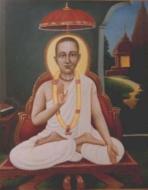
Rudra Vaisnava Sampradaya:
It may be put forth that activities such as farming sometimes fails to produce results due to natural phenomena such as variations in weather, drought, flooding etc. Also it may be submitted that there are chances of incurring reactions in the performance of spiritual rituals if the mantras are spoken improperly or if there are any defects performing the prescribed Vedic ceremony. So there may be some doubt regarding how bondage from actions can be effectively neutralised by karma yoga or the science of the individual consciousness attaining the Ultimate consciousness by performing actions as a matter of duty. These doubts are now being alleviated in this verse where it states that by the path of karma yoga, being free from fruitive desires there is no loss or diminution from any endeavour which is undertaken in righteousness nor is any effort wasted as is the case with actions having fruitive desires. In this there is no possibility of incurring any sin or reaction from such actions as these actions performed in righteousness are surrendered to the Supreme Lord and completely free from the desire of fruitive results. Moreover even the smallest amount of effort on this path of righteousness saves a living entity from the great danger of transmigration of being born again and again in the material existence endlessly.
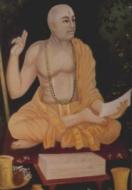
| Brahma Vaisnava Sampradaya:
In the Agni Purana it is stated: That pseudo devotion, inconsistant devotion and defective devotion due to insufficient knowledge or deviation from the Vedic injunctions renders any chance for reciprocation with the Supreme Lord as futile and in vain. Keeping in mind the preceding words it can be seen that even without any intention whatsoever of propitiating the Supreme Lord; by the performance of righteous actions without any desire for reward or recognition, whether complete or incomplete righteousness is most certainly accrued to the followers of the Supreme Lord regardless. This eternal truth was initiated in the Satya Yuga for the benefit of the worlds in the Vedic scriptures. Except by the mercy of the Supreme Lord pleasure neither a drop of rain may fall; nor a blade of grass may grow. A spiritually intelligent living entity should always be a humble servant of the transcendental Supreme Lord Krishna serving Him with loving devotion without any desires. A living entity reading this material should understand it completely should never have any reservation that there is anything equal to or superior to Him. One should understand that according to revealed scriptures everything in existence has been created by Him and everything in existence is subordinate to Him. Accordingly even the gradation of His eternal and phenomenal incarnations and expansions is determined. These eternal truths initiated by the Supreme Lord Himself are fruitful in Treta Yuga, especially fruitful in Dvarapa Yuga and most especially fruitful in kali yaga. Therefore it should be clearly understood that the blessing of salvation can only be bestowed upon those who by spiritual knowledge have factually attained actual communion with the Supreme Lord Krishna. The Vedic scriptures are eternal and are instruments of superior knowledge. Righteousness or dharma is also superior and of much more import than the propitiation of various demigods. Even better than all is having factual knowledge of the Supreme Lord is the best of all attributes. Whatever is offerred at the summation of yagna, that verily is for the Supreme Lord. Those knowers of the Vedas return to earth again after enjoying the celestial spheres and again performing meritorious service to the Supreme Lord they again go to the celestial spheres. Awareness of the status and gradation of the various demigods and performing actions which are beneficial to them brings with it similar results in the material existence. However without having comprehensive knowledge according to the Vedic scriptures of the paramount position of the Supreme Lord Krishna, as the Supreme Lord over all there is, all ones prayers, penance and longing for heavenly realms will be in vain; for without relinquishing attachment to the senses and without constant remembrance of the Supreme Lord Krishna even knowledge of the Vedas is in vain. But still due to having some piety they gradually are redeemed by the Supreme Lord at the end when they have realised that surrendering all actions unto the Supreme Lord according to the Vedic injunctions after living many lives performing meritorious actions. One who has not realised the Supreme Lord Krishna's paramount position over all there is, even if they perform all the rituals enjoined in the Vedas cannot be spoken of as a real knower of Vedanta. The word vada means speech. One who speaks about the Supreme Lord Krishna who is the Ultimate goal of the Vedas without factually understanding His Supreme position is merely theoretical. One should not be engrossed in debative arguments about the Vedas with living entities of no piety or to those who purposely perform sinful activities or to those who are incorrigible. These unfortunate living entities descend to the worlds of obscurity and darkness perpetually and which are without a beginning and an end. In the Vedic scriptures these worlds are known as vavra meaning from whence there is no return and were dwell living entities languishing in nescience.
| ||
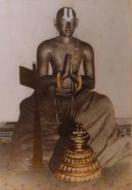
Sri Vaisnava Sampradaya:
Ramanuja.
Bhagavad-Gita: chapter 2, verse 41 The Supreme Lord Krishna is reaffirming that the science of yoga rather than the various methods of action prescribed in the Vedic scriptures is the one path that has guaranteed certainty. The word vyavasaya derived from nischaya means certainty. The unshakeable conviction one has of such a decisive nature is that which the aspirant of salvation possesses and which can be understood by the actions they perform. The strength of this unshakeable conviction is directly connected to one's understanding of the eternal reality of the soul's immortality. Fragmented and not evolved is that mind which entertains ideas of performing actions for the reaping of results. People of this type vaguely know that the soul exists, although mistakenly attributing it as being part of the body and no more knowledge is required in their case as their material wishes for wealth and fame and even heaven can be obtained without having accurate, precise knowledge of the actual transcendental position of the eternal soul. But on the other hand the conviction of certainty is unique in its singleness of purpose and focused aim. All actions executed by such a living entity has for its sole objective salvation and the means is yoga which is the science of the individual consciousness attaining communion with the Ultimate Consciousness. This is the essence of the Vedic scriptures which lead to this conclusion and such being the case there can arise only one unshakeable conviction to one possessing spiritual insight.
For the fulfilment of one single attainment being salvation all actions are dedicated by one fixed in the firm resolve for salvation. Hence as the primary objective of the Vedic scriptures is one, the firm resolve as regarding the purpose of all actions can be but one as in the case for example of the six different kinds of rituals called Darsa-purnamasa. Three rituals are to be performed on the new moon and three are to be performed on the full moon. In their performance they all differ in regards to execution yet they may be said to constitute a single aim for when all are directed to obtaining a single fruit all there seperate differences may be understood as part of a whole. Whereas in the case of those with fragmented and unfocused minds who engage in various activities each intended to acquire some result such as heaven, wealth, fame, power and so forth and so on the schemes are endless as the desires are endless. Even the results are diverse as in the case again of the Darsa-purnamasa, for although the rituals are directed to be performed for the obtainment of a specific goal, yet they confer minor benefits as well such as good health, vigor and long life. Thus it is stated that the mentality of those not evolved is endless and ramifying. The conclusion of this verse is that all nitya or daily rites and all naimittika or occasional rites for specific times prescribed in the Vedic scriptures shall be performed with the sole aim of ultimate salvation as the purpose. Although each rite individually is capable of giving its own temporary, material reward; but all such rewards are to be ignored while holding focus solely on salvation. As for fruitive rites and rituals desiring some material benediction, these shall be performed in the manner prescribed for the four varnas or classes of cultured life being brahmana, ksatriya, vaisya, and sudra in the four asramas or stages of cultured life being brahmacarya or celibate life, grihasta or married life, vanaprastha or renunounced life and sannyasa or dedication and focus solely on the Supreme Lord. Accordingly they should also resign the acquired results of their efforts in favor of salvation. In the next three verses will be seen that those who engage solely in fruitive activities are condemned.
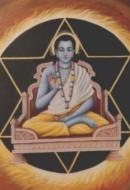
| Kumara Vaisnava Sampradaya:
In the normal course of events actions and merits have a finish at the end of ones lifetime. The actions have a conclusion in this world and the merits have a conclusion in the next world. It is likened as to a farmer tilling his crops, by industrious action the merits of an abundant harvest are assured. But if he is to omit any of the steps such as watering or pruning within the process the harvest is put into jeopardy. Similarly the demerit of non-comittance by Arjuna is also possible if any action of his duty is not performed. In this regard then by only acting without fruitive desires does not guarantee freedom from the shackles of bondage in the material existence. But here Lord Krishna explains in bhakti-yoga which is His exclusive loving devotional service there is an exemption to the aforementioned rule and that there is never any loss or dimunition to those who are fortunate enough to perform bhakti-yoga in this lifetime or any lifetime. Unlike the cultivation of farming which is always beset by problems of weather, drought, blight and numerous unexpected difficulties. In bhakti-yoga there is no chance of contrary results or fear of demerits in committance or non-committance when carrying out devotional service for the ultimate satisfaction of the Supreme Lord. Hence even the slightest effort in the cultivation of bhakti-yoga which is without fruitive desires and which is also known as acting selflessly assures one complete protection and inevitably saves one from transmigration and the endless cycle of birth and death in the material existence.
|