Chapters



Sanskrit Vocal
Transliteration

Anvaya

Translation



Audio
 | Hindi | |
| Bengali | |
 | English | |
 | Dutch | |
 | German | |
 | Greek | |
 | Chinese | |
 | Japanese | |
 | French | |
 | Spanish | |
 | Italian | |
 | Portuguese | |
 | Hebrew | |
 | Arabic | |
 | Serbian | |
 | Russian |
| Chapter 3 | The Eternal Duties of a Human Beings | Verse 8 | ||||||||||||||||||||||||||||||||||||||||||||||||
Chapters |
Sanskrit Vocal
Transliteration
Anvaya
Translation
| Audio
|
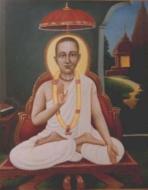
Rudra Vaisnava Sampradaya:
One should perform the duties prescribed in the Vedic scriptures appropriate for ones stage in life. The daily duties like praying, meditating and worshipping are being referred to by Lord Krishna. Action is superior to inaction for by abstention from action none of these activities can be accomplished. What to say of those, if one fails to take actions even the maintenance of their physical body will not be possible.
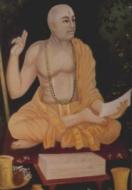
| Brahma Vaisnava Sampradaya:
One should perform the actions that are appropriate to one's varna or status and ashram or stage in life. In Vedic culture there are four varnas: brahmin the priestly class, kshatriya the royalty and warrior class, vaishya the farmers and businesss classes and sudra the workers and servants of the previous three classes. In Vedic culture there are also four ashrams: bramacharya which is celibate student life, grihasta which is married family life, vanaprastha which is semi-retired householder life and sannyasa which is complete renunciation of worldy life for meditation on God. Due to changing times and the unseemly mixture of different varnas people no longer adhere exclusively to the natural duties of their ashram as prescribed by the Vedas. This was even happening over 5000 years ago at the end Dvarpara yuga. In the Mahabharata we see King Yudhisthira noting that it was becoming exceedingly difficult to determine the varna of people due to the mixture of different classes. Therefore it is only by conduct and attributes that one can judge what class one belongs to and not simply by what varna one was born into and this conduct is determined by actions. Unless and until the impulse arises for one to surrender themselves in full service and devotion to the Supreme Lord Krishna then both varna and ashram apply in society. But after surrendering in devotion varnashram is no longer applicable or required.
| ||
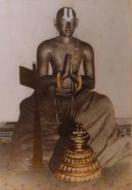
Sri Vaisnava Sampradaya:
The word nityatam can refer to eternal, regular or even daily. An act is eternal if it is connected to the atma which is the eternal soul. Actions merely connected to prakriti or the material nature are a persistent inheritance from one's past activities in the unknown past. Thus to perform actions comes easily as a natural phenomena and not subject to the inherent dangers of possessing an impure mind or the lack of sense control associated the with jnana yoga, the cultivation of spiritual knowledge. Therefore Lord Krishna is urging Arjuna to perform karma yoga or actions without attachment as in his case it is superior to cultivating knowledge. A-karma is non-action which implies cultivating knowledge by the abstention of activities. But it is known that it is not possible to completely achieve the actionless state. Even for the followers of jnana yoga the path of karma yoga is superior because in jnana yoga one must follow a path one is naturally not accustomed, is difficult to practice, fraught with the risk of dominant senses and also which does not flow as an inherent tendency like the path of karma yoga where actions follow the natural locomotion of the body in the course of daily activities.
Further it will be shown that even one who is liberated by atma- tattva realisation of the eternal soul; still may be involved in so many activities, performing actions without attachment or as a matter of duty. Thus even atma-tattva can be connected to material activities transforming them to spiritual activities. Hence karma yoga can be superior in this way. What can be inferred about the superiority of karma yoga over jnana yoga will be evident to one who is actually engaged in practising jnana yoga.
But an alternative argument could be alright suppose one is determined to abstain from all actions, then how does one expect to maintain their bodily existence which depends on eating and sleeping and washing and exercising etc. and by which the body is very helpful and useful in practising jnana yoga. The maintenance of one's physical body is absolutely essential to complete the course charted in life until one achieves their goal. The way in which one maintains their body is by actions such as labour by rightful means to acquire funds for performing worship to God by offerings of food which are subsequently imbued with spiritual potency and by partaking of the remnants of such foods solely for bodily sustenance each day maintain their bodies.
In the Chandogya Upanisad VII.XXVI.II we find: It is by the purity of food that one's mind becomes purified. When the mind is purified one attains access to the eternal soul dwelling within the heart.
Thus if one desires to desist from all activities how will their mind become purified and how will their bodily needs be maintained? Thus it is obvious that one who practices jnana yoga in order to maintain their bodily existence must still continue performing the daily and occasional duties prescribed in the Vedas until they reach their goal. The same as if one practised karma yoga. Also in karma yoga the contemplation of atma-tattva is also included in the conceptions that I am not my body perfoming actions and I am not the actual doer of any actions. So for all these reasons karma yoga is preferably recommended to jnana yogis.
So the conclusion is for Arjuna to desist and practice karma yoga.
But if it is still postulated that actions such as the acquiring of funds involves the my-ness of this is my money and the I-ness of I have earned this by the strength of my mind and the power of my faculties and that these efforts must cause bondage Lord Krishna refutes this argument in the next verse.
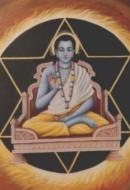
| Kumara Vaisnava Sampradaya:
One should note that by the use of tvam Lord Krishna is asserting that Arjuna should be detached from his actions and perform his duty. Action is superior to inaction because by performing actions prescribed in the Vedic scriptures according to one’s occupation and stage in life because accumalated sins are destroyed that one has acquired in past lives. Realistically not performing actions is also not practical because without actions one is not able even to maintain the physical body. The particle api means even and refers to what else more should be clarified.
|