Chapters



Sanskrit Vocal
Transliteration

Anvaya

Translation



Audio
 | Hindi | |
| Bengali | |
 | English | |
 | Dutch | |
 | German | |
 | Greek | |
 | Chinese | |
 | Japanese | |
 | French | |
 | Spanish | |
 | Italian | |
 | Portuguese | |
 | Hebrew | |
 | Arabic | |
 | Serbian | |
 | Russian |
| Chapter 3 | The Eternal Duties of a Human Beings | Verse 35 | ||||||||||||||||||||||||||||||||||||||||||||||||
Chapters |
Sanskrit Vocal
Transliteration
Anvaya
Translation
| Audio
|
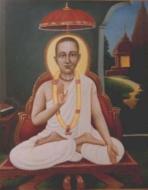
Rudra Vaisnava Sampradaya:
One should engage themselves in their duties overriding one's normal inclinations which are even seen to be in the natures of animals. One maybe would like to switch their duties for anothers but it is very risky that the duties one was never trained for would be as successful as the duty that one was well versed in. Engaging in ones own duty one possesses the correct inner mentality to accomplish it; but for engagment in another's duty the correct inner mentality would not be present even if the external action was performed perfectly. There might be worry or indecision and questions regarding some aspects of another's duty and unresolved these would lead to inner conflict which is very detrimental for one's consciousness and atma tattva or soul realisation. This is Lord Krishna's meaning.
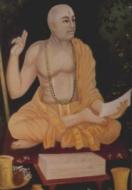
| Brahma Vaisnava Sampradaya:
In this verse Lord Krishna is emphasising the fact that one should perform the duties one is authorised to do according to one's station and rank in society. Arjuna was a royal prince educated and trained by the strength of his might to uphold and protect dharma or righteousness and although war enacts terrible suffering it was necessary and was appropriate for Arjuna to engage in it.
| ||
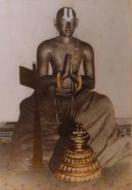
Sri Vaisnava Sampradaya:
For obvious reasons the performance of one's own dharma or righteous duties according to karma yoga or actions performed according to prescribed Vedic injunctions is the best course to follow even if they do not possess great virtues. One's own duties are easy and natural to discharge in karma yoga and unattended with risk. Whereas that person performing jnana yoga or the path of cultivating Vedic knowledge which is most excellent; but who is beguiled by prakriti or material nature finds it extremely difficult to achieve success. Although the path of jnana yoga is shorter than the path of karma yoga there are many dangers accosting the path of jnana yoga. The path of karma yoga is performed by one most easily as it naturally befits the person performing it. Even if death comes before one has the opportunity to fulfill life's purpose and attain moksa or liberation form the cycle of birth and death, still one's progress is not impeded by any obstacle even death as one's merits are applied to the next life and they are born in a situation where they can easily pick up the thread from where they left off in the last life and continue on. Whereas one who although beguiled by prakriti attempts to practice jnana yoga anyway is surrounded by danger and obstacles on their path which deter one from easily adopting and putting into practice the cultivation of Vedic wisdom.
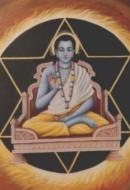
| Kumara Vaisnava Sampradaya:
It should not be presumed that a person abstaining from a negative direction to pursue the ascetic life of non- violence, meditation, virtuousness and self-satisfaction seems superior for worshipping the Supreme Lord. What is therefore the purpose of a warrior’s duty to perform cruel deeds upon the battlefield in pursuit of victory and self-preservation. Anticipating such a doubt Lord Krishna states it is better to follow one’s own duties according to station and rank in life as enjoined by the Vedic scriptures. Because to perform another’s duty is not authorised in the Vedic scriptures and being prohibited is fraught with dangers. According to te scriptural injunction: One who exempts themselves from their prescribed actions as enjoined in the Vedic scriptures, is never qualified to perform the prescribed actions of a higher station. Such actions is prohibited.
|