Chapters



Sanskrit Vocal
Transliteration

Anvaya

Translation



Audio
 | Hindi | |
| Bengali | |
 | English | |
 | Dutch | |
 | German | |
 | Greek | |
 | Chinese | |
 | Japanese | |
 | French | |
 | Spanish | |
 | Italian | |
 | Portuguese | |
 | Hebrew | |
 | Arabic | |
 | Serbian | |
 | Russian |
| Chapter 9 | Confidential Knowledge of the Ultimate Truth | Verse 15 | ||||||||||||||||||||||||||||||||||||||||||||||||
Chapters |
Sanskrit Vocal
Transliteration
Anvaya
Translation
| Audio
|
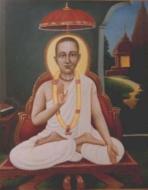
Rudra Vaisnava Sampradaya:
The word upasate means worship. Lord Krishna is explaining that knowledge of Him as the universal form of all creation and realisation of Him as paramatma the Supreme Soul in every sentient being is also worship of Him. Everything is a part of the Supreme Lord Krishna and even knowledge of this is an oblation and offering to Him in adoration. Some worship the Supreme Lord as being non-separate from themselves, others worship Him as being distinctly different thinking He is the Supreme and I am His humble servant. Still others worship the Supreme Lord Krishna in His guna forms or manifestations of Brahma and Shiva or any of His other sixfold avatar or incarnation forms such as Rama, Buddha or Narasimha as well as His expansions in Vaikuntha the eternal spiritual worlds where He expands Himself in forms such as Narayana, Sankarsana, Vishnu and Jagannatha.
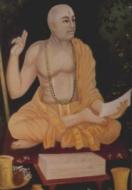
| Brahma Vaisnava Sampradaya:
The Supreme Lord Krishna exists in all places. This means that He is omnipresent everywhere in a unified manner and it also means that He exists in special forms authorised in the Vedic scriptures that have extraordinary attributes and phenomenal qualities. In the Sanat Sujati it is stated: In the four yugas or ages He is of whitish hue, reddish hue, blackish hue and golden hue. So the Supreme divinity may be perceived extensively in unlimited ways at all times as the one as the many and His own personal distinct forms as well.
Now begins the summation.
The knowledgeable and noble minded worship Lord Krishna in His own individual two armed form or in His four armed expansion as Narayana the Lord of Vaikuntha the eternal spiritual worlds. They also may worship Him as Caturvyuha or His fourfold expansions of Vasudeva, Sankarsana, Pradyummna and Aniruddha as well as any of the caturvyuha's twenty expansions such as Keshava or Purusottama from Vasudeva, Govinda and Vishnu from Sankarsana, Narasimha and Vamana from Pradyumna and Hari and Damodara from Aniruddha. They may also worship Him as any of His sixfold incarnations being Purusa Avatars, Lila Avatars, Guna Avatars, Manvantara Avatars, Satyavesha Avatars and Yuga Avatars.
| ||
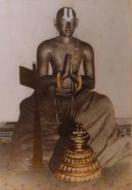
Sri Vaisnava Sampradaya:
The mahatmanas or those of great souls discuss, sing and reflect on the glories of Lord Krishna without abatement in what is called jnana yagnena or propitiation by knowledge. How is this to understand? By constant meditation of Him as the unity comprising the infinite variations of unlimited diversity displayed in creation as the form of the cosmos. The essence of understanding this phenomena is as follows. The Supreme Lord Krishna alone is the sum total of all having within His spiritual body the most fine and supra subtle state chit or the principles of consciousness and also that of achit or inconsciousness without names, forms and distinctness. By His indomitable will the Supreme Lord resolves to manifest from His spiritual body consciousness and inconsciousness into their relative material states having names, forms and distinctness. Thus the Supreme Lord Himself being the totality of all is perceived in His manifested cosmic form exhibiting the marvelous variegations of existence such as the heavenly demigods, humans, flora, fauna and aquatic as well as the stationary kingdoms. Contemplating the Supreme Lord as all inclusive they are worshipping Him. Therefore He is declared to be the universal form.
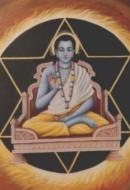
| Kumara Vaisnava Sampradaya:
The most excellent mahatmanas or great noble souls worship the Supreme Lord Krishna by jnana yagnena or propitiation by knowledge. Other mahatmanas chant His names and glories and also by propitiation of knowledge offering worship to Him in His universal cosmic form facing all directions in all locations as the all pervasive paramatma or supreme soul within all living entities. In the Chandogya Upanisad III.XIV.I it states: Verily the whole creation is brahman or the Supreme Lord's spiritual substratum pervading all existence. Tranquilly one should worship it as the source from whence one came forth, as that source to where one will go hence and as that in which one breathes. All creation is verily the paramatma of the Supreme Lord Krishna. Everything is Lord Krishna, He is omnipresent, the highest person, the one and only Supreme Lord. He is realised as the universal cosmic form of all existence comprised of phenomenally unlimited variations of all animate and inanimate beings. The Katha Upanisad V.XIII states: The Supreme Lord who is constant among the inconstant, intelligent among intelligences, the one among the many, who grants desires. In the Brhadaranyaka Upanisad III.VII.II states: That he who dwells in the earth does not know whose body the Earth is or who controls the Earth from within is the atma or immortal soul, the inner monitor and controller. The Katha Upanisad V.X.XI states: As one wind has entered the world and becomes corresponding in form to every form, so the one inner atma of all things is corresponding in form to every form and yet is separate from them. As the sun which is the eye of the universe shining upon everything is not compromised by the external faults of the eyes; in the same way the immortal soul of all beings is not compromised by the evil manifesting in the world, being external to it. Thus the most excellent great souls worship the Supreme Lord Krishna as totally different from this universe comprised of animate and inanimate beings because although He is within all various diverse and variegated forms as paramatma He is completely unaffected by them.
|