Chapters



Sanskrit Vocal
Transliteration

Anvaya

Translation



Audio
 | Hindi | |
| Bengali | |
 | English | |
 | Dutch | |
 | German | |
 | Greek | |
 | Chinese | |
 | Japanese | |
 | French | |
 | Spanish | |
 | Italian | |
 | Portuguese | |
 | Hebrew | |
 | Arabic | |
 | Serbian | |
 | Russian |
| Chapter 11 | The Vision of the Universal Form | Verse 14 | ||||||||||||||||||||||||||||||||||||||||||||||||
Chapters |
Sanskrit Vocal
Transliteration
Anvaya
Translation
| Audio
|
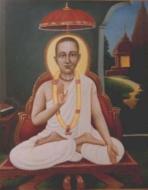
Rudra Vaisnava Sampradaya:
Having witnessed Lord Krishna's visvarupa or divine universal form what did Arjuna do next? Sanjaya explains that Arjuna filled with wonder and amazement by seeing the universal form, with all his hairs electrified and standing on end through joy and exaltation, bowed his head in obeisance to Lord Krishna and reverently joining his palms together as in prayer began to speak.
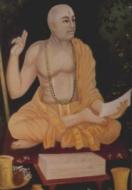
| Brahma Vaisnava Sampradaya:
Beholding the Supreme Lord Krishna's brilliant and magnificent immutable equanimity in His visvarupa or divine universal form comprised of boundless marvels and unlimited wonders establishing His infinite forms all fully endowed with saccidanda or eternal consciouness, unlimited knowledge and endless bliss. These forms are all contained within the Supreme Lord Krishna's spiritual body and exist simultaneously one and distinct from Him. His universal form, His eternal form and so many other forms were seen by Arjuna. So since both singular and plural words were used the Supreme Lord Krishna is established to be distinctly singular as well as being distinctly unlimited with innumerable forms. Now begins the summation. The original form of the Supreme Lord Krishna is eternal, graced with flute, gunga beads and peacock feather. This singular form is inconceivable because of the splendor of it being the exclusive source of all avatars or divine incarnations and expansions possessing unlimited transcendental forms. Where the absence of separation is fully established then the individual forms assume phenomenal activities with extraordinary attributes. Yet Lord Krishna is the Ultimate controller of each and every one of them and as their essence from Him the one becomes the many. Even though eternity is His special quality He still sometimes appears simultaneously in different lil?s or divine pastimes which while having variegated and diverse forms are similarly eternal as well. Through personal experience and devout contemplation, subsequent realization will manifest and the distinctive spiritual essence of everything will be discovered. This essence may be perceived by meditation, by reflection or by enlightenment. But the variation in form of the essence is not distinct or separate from the essence itself for if the form of the essence is separate from the essence then it would not be one and eternal. Also if the form of the essence is not knowable then the essence would also be unknowable and as such would not be cognizant. Despite the absence of contradiction in the statement that the essence and the form of essence are the same and different, knowledge of the form of essence will not lead to the knowledge of the nature of the essence itself. While one is knowable by its form the essence is known only by realization. Yet even though there is difference in the means of knowing the essence and the form of the essence this by itself does not constitute any demerit. Thus something which knowable by one method can also be unknowable by other methods. Still this does not result in the possibility of any defect regarding knowledge acquired. One avatar is not distinct from another because of their differences in form or the differences in their special attributes and lil?s or divine pastimes and one who does not experience separation from the Supreme Lord does not feel any difference from Them. Thus it is apparent that there can never be any difference between the essence and the form of essence. The form is completely spiritual and totally transcendental and so is the essence and there never can be any separation between the two. Similarly even in the performance of actions the essence of strength and wisdom never come to be experienced as separate from the essence itself. Such non- distinction however is seen as separate and distinct only when it is perceived in the material conception of gross physical bodies and when such separateness is experienced in the essence as being different it is due to a figment of the imagination and attachment to material nature all caused by susceptibility to illusion. In non-sentient objects there is neither distinction or non-distinction. The experience of distinction and non-distinction does not manifest even if one conceptualizes because in non-sentient objects there is separation between the essence and the form. In the case of sentient beings however, even though there is an awareness of being non-distinct there arises a multitude of experiences of distinction between themselves and the forms of essence. The yarn in the cloth appears as non-distinct in the cloth but each thread comprising it is different from each other. From the distinction in the thread the non-distinction in the cloth comes about. So even though the atma or eternal soul has unlimited distinct forms of essence they are not comparable with the yarn because the separate identity of each thread will continue to remain distinctive. The atma is pure and due to inner realizations of the soul every soul can be identified as being distinct and separate as well as having common identity with all other souls. In the case of the yarn each thread although distinct and separate can never experience the common oneness with the cloth. Nothing can ever exist without any parts in its possession. Even atoms have a prior state and a later state but by this one cannot conclude that the atom is made of parts. Atoms which possess protons, neutrons and electrons give credence to the sublime interrelation of all existence although in their separated states of protons, neutrons and electrons a change in the attributes would occur and a change in the entirety would be predicated. If such changes in the relationship of atoms are possible then it is impossible to deny the existence of difference in material objects which are comprised in totality by atoms. In sentient beings the qualities and attributes of the atma exist in a latent form, pregnant with potential, powerful and all knowing. Therefore between sentient beings and the eternal essence there exists an extremely subtle connection perpetually even from one life to the next. In non- sentient objects there exists nothing but the energy of the atoms comprising the form which are mere parts of prakiti or the material substratum pervading physical existence. For the non-sentient nothing else exists. Death denies eternity to those who perceive otherwise. As rain water falling on the top of the mountaintop descends downwards. One who thinks that the nama or name, rupa or form, guna or attibutes, lila or divine pastimes and dhama or holy abode of the Supreme Lord Krishna or any of His authorised incarnations and expansions to be distinct and separate from Him in any way will also fall down from the higher levels of exitence. The Brahma Tarka states: That all the Vedic scriptures accordingly make it evidently clear and also the sacred discourse of Srimad Bhagavad-Gita by the resplendent Supreme Lord Krishna also definitively affims that all activities and manifestations originate and terminate in Him alone by His vibhuti or divine transcendental opulence and magnanimous and compassionate nature.
| ||
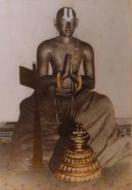
Sri Vaisnava Sampradaya:
Perceiving the entire cosmos with unlimited wonders and marvels within just a part of Lord Krishna's visvarupa or divine universal form which contained innumerable glorious qualities and attributes such as omniscience and omnipotence etc. Arjuna with the hair on his head standing on end became petrified with astonishment in rapturous exultation and like an inanimate rod fell prolong upon the earth prostrating himself with head bowed and hands folded in reverence exclaiming.
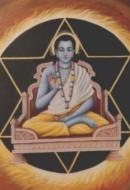
| Kumara Vaisnava Sampradaya:
What happened after seeing Lord Krishna's visvarupa or divine universal form is now being explained. After beholding this amazing form Arjuna overcome with wonder is astonished by the sight of this supremely transcendental and omnipotent reality. With hairs standing on end he prostrated himself upon the ground with hands humbly joined together.
|