Chapters



Sanskrit Vocal
Transliteration

Anvaya

Translation



Audio
 | Hindi | |
| Bengali | |
 | English | |
 | Dutch | |
 | German | |
 | Greek | |
 | Chinese | |
 | Japanese | |
 | French | |
 | Spanish | |
 | Italian | |
 | Portuguese | |
 | Hebrew | |
 | Arabic | |
 | Serbian | |
 | Russian |
| Chapter 2 | The Eternal Reality of the Soul's Immortality | Verse 10 | ||||||||||||||||||||||||||||||||||||||||||||||||
Chapters |
Sanskrit Vocal
Transliteration
Anvaya
Translation
| Audio
|
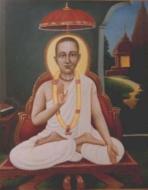
Rudra Vaisnava Sampradaya:
What happened then after this? In answer it is stated: to Arjuna who was lamenting between the two armies the Supreme Lord spoke as if smiling , meaning spoke with a beaming countenance.
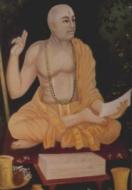
| Brahma Vaisnava Sampradaya:
Lord Krishna, the resplendent one, situated between the 2 armies, with a slight smile upon His face spoke to the grief stricken Arjuna who was enveloped by the entanglement of fraternal delusion.
| ||
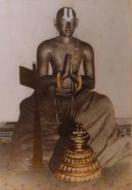
Sri Vaisnava Sampradaya:
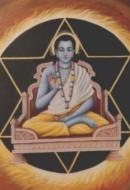
| Kumara Vaisnava Sampradaya:
In this way although Arjuna had decided to refrain from the battle still Dhritarastra should not expect that the future of his sons was to be bright and happy as long as the Supreme Lord Krishna, the controller of the animate and inanimate who descended personally to destroy the miscreants is present in this world. To emphasize this reality Sanjaya said to him O Bharata referring to his anscestor, the great monarch of all the world King Bharata telling frankly that the joy he is feeling regarding Arjuna's seemingly abstention from the battle and the termination of the war was not appropriate. Lord Krishna with a subtle smile upon his face then spoke to Arjuna who was lamenting at a most inappropriate time between the 2 opposing armies. The word prahasan meaning smiling is used to subtlely indicate sarcasam and evoke anger at the impropriety of such limpid sensitivity by Arjuna who in his own right is a mighty warrior respected and reknowed by all the mightiest warriors of his time. This smile indicating sarcasm is justified by the use of the word iva as it were indicating that due to the nature of the situation, being the 2 armies immeadiately ready for battle, Arjunas reluctancy and Lord Krishna accepting him as a disciple. So in order to substantiate Arjunas fitness to receive spiritual knowledge this subtle smile is used to remove any lingering vestiges of pride Arjuna might have had regarding his knowledge, intelligence and prowess.
|