Chapters



Sanskrit Vocal
Transliteration

Anvaya

Translation



Audio
 | Hindi | |
| Bengali | |
 | English | |
 | Dutch | |
 | German | |
 | Greek | |
 | Chinese | |
 | Japanese | |
 | French | |
 | Spanish | |
 | Italian | |
 | Portuguese | |
 | Hebrew | |
 | Arabic | |
 | Serbian | |
 | Russian |
| Chapter 11 | The Vision of the Universal Form | Verse 2 | ||||||||||||||||||||||||||||||||||||||||||||||||
Chapters |
Sanskrit Vocal
Transliteration
Anvaya
Translation
| Audio
|
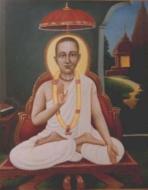
Rudra Vaisnava Sampradaya:
Arjuna continues his assessment of Lord Krishna's glories by confirming His eternal almighty paramount position as the creator and destroyer of all existence at will. Although He is the source of all creation, the absolute supreme ruler of all existence, the witness of all actions and the dispenser of all results from actions such as moksa or liberation and baddha or bondage in samsara the perpetual cycle of birth and death. Yet understanding Lord Krishna's immeasurable majesty consisting of impartiality, stability, non-attachment, preservation, compassion, etc. for all living entities who are all completely dependent on Him, Arjuna's delusion of being the actual controller of his destiny has been removed.
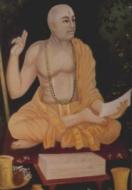
| Brahma Vaisnava Sampradaya:
Those who do not know the supreme, paramount position of Lord Krishna and being unaware of this do not propitiate Him and worship Him oblivious to the fact that He alone is Sri Laxmi's lord and master will be verily cursed by her even if they offer her worship. Therefore knowing the paramount supremacy of the Supreme Lord Krishna and the exalted position of offering propitiation to Him one should meditate on His sakti or spiritual, feminine potency known as Sri Laxsmi. Being pleased by this she will happily facilitate devotion to Lord Krishna and after realizing the reality that He alone is the Supreme Lord of all, one will easily achieve moksa or liberation from material existence and attain eternal communion with Him in the immortal spiritual worlds. Of this there is no doubt. One who knows that Sri Laksmi being free from all defects is the eternal, spiritual, feminine potency of the Supreme Lord and that as His consort she is always propitiating Him in full wisdom, such a one is supremely superior. Contrarily, great is the distress for those who propitiate Lasxmi independently, separate from the Supreme Lord. The Parama Scripture states: If Sri Laxsmi is propitiated and worshipped along with the Supreme Lord then great bliss and blessings manifest; but if the Supreme Lord is considered to be an adjunction to her worship and necessary because she is His consort, then she will not be pleased and the opportunity to achieve moksa will be blocked. Therefore only those who propitiate the Supreme Lord Krishna and any of His authorised avatars or incarnations and expansions is eligible for moksa and Sri Laksmi expands herself eternally to be the individual consort of each of them whenever and wherever they manifest themselves.
| ||
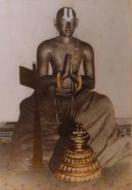
Sri Vaisnava Sampradaya:
Likewise from the seventh chapter till the end of chapter ten, Lord Krishna has revealed the reality of the emanating of all beings from Him as well as the influx of all beings back into Himself. The word avyayam means imperishable and mahatmyam means the majesty and greatness of being neutral to all things sentient and insentient although being their source, due to complete omniscience, omnipotence and omnipresence along with unlimited vibhuti or divine transcendental opulence as the controller of every breath, every thought and every action being the foundation of everything. The word hi meaning certainly is an adverb indicative of the forthcoming vision of Lord Krishna's universal form.
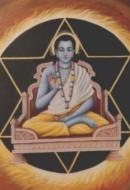
| Kumara Vaisnava Sampradaya:
Lord Krishna is addressed in the vocative with the words kamala-patra-aksa meaning whose eyes are large and beautiful like the petals of a lotus flower and denotes His qualities of sweetness and softness of form as well as the repository of charm and beauty in look. The reality of His vibhuti or divine, transcendental opulence has been understood as well as His being the source of creation and dissolution for all beings in all existence. Although Lord Krishna is the doer of all He is the non-doer as well for these things manifest automatically from Him. Although He is the controller of all, He is impartial. Although He is present within all He is untainted by their imperfections. Although He directs all according to karma or reactions from righteous or unrighteous actions He is not unfair. Although He bestows the results of everyone's righteous or unrighteous actions He is not cruel. He is equal to all though He bequeaths various results such as moksa or liberation, baddha or bondage, etc. He is equal to all. He is the absolute controller of primordial matter, time consisting of past, present and future, the object of adoration for all beings, unassailable by everyone, unconquerable by anyone, whose will is indomitable, unable to be transgressed and who has the compassionate nature of destroying the impediments and obstacles of His devotees. Such infinite greatness has been understood and assimilated by Arjuna.
|