Chapters



Sanskrit Vocal
Transliteration

Anvaya

Translation



Audio
 | Hindi | |
| Bengali | |
 | English | |
 | Dutch | |
 | German | |
 | Greek | |
 | Chinese | |
 | Japanese | |
 | French | |
 | Spanish | |
 | Italian | |
 | Portuguese | |
 | Hebrew | |
 | Arabic | |
 | Serbian | |
 | Russian |
| Chapter 12 | The Path of Devotion | Verse 11 | ||||||||||||||||||||||||||||||||||||||||||||||||
Chapters |
Sanskrit Vocal
Transliteration
Anvaya
Translation
| Audio
|
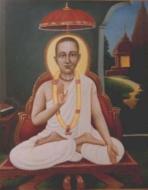
Rudra Vaisnava Sampradaya:
If one is still unable to fulfil the practices of steadfast devotion to Lord Krishna, or succeed in repeated training of a distracted mind to remember the Supreme Lord with regularity or are even not able to perform occasional rituals and ceremonies propitiation to Him then Lord Krishna gives the sagacious advice to take complete refuge in Him alone with controlled senses, performing one's Vedically authorised activities according to time and circumstances solely as an offering to Him without desire for rewards. If one desires even the slightest reward either subtle such as prestige and recognition or gross such as wealth and position, one's actions can never manifest as bhakti or exclusive loving devotion to Lord Krishna and without bhakti there will be for certain a reaction and the need for a subsequent attempt to neutralise it by obligatory rites such as Agnihotra. The following is what is meant by surrender: All I can do is to perform all activities under the command of the Supreme Lord according to my ability with the guidance of guru, Vaisnavas and sastra or Vedic scriptures; but the results whether visible or invisible are all in the hands of the Supreme Lord. If one who is Lord Krishna's devotee, renounces the desire for rewards and lives their life fully surrendered to Him, leaving all responsibility for even their daily maintenance unto Him, He will protect them and they by His grace will attain eternal communion with Him.
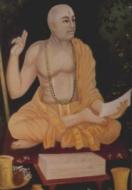
| Brahma Vaisnava Sampradaya:
In this verse Lord Krishna shows that for His devotees there are no obstacles and impediments in their way at all by demonstrating the alternatives. It has been stated in the Saukarayan scripture: What value is the worship of the avyaktam or the impersonal unmanifest for those who propitiate the Supreme Lord Krishna? Also the Moksa Dharma also reiterates this theme stating: Rejecting all other gods and deities, those devotees who perform bhakti or exclusive loving devotion to the Supreme Lord Krishna are indeed the most superior. The reason being that the performance of bhakti is performed exclusively for the satisfaction of the Supreme Lord without any expectation of any rewards because Lord Krishna Himself is their only goal and attainment of Him is all they desire.
| ||
Sri Vaisnava Sampradaya:
With a view of attaining communion with the Supreme Lord Krishna, His devotees enthusiastically perform bhakti or exclusive loving devotion to Him. When the followers of this path who are always reflecting and reminiscing about His nama, rupa, guna, lila, dhama find themselves due to adverse circumstances unable to perform all their activities for Him alone by which association with Him in loving communion would surely manifest; then let them launch on the path of aksaram or the imperishable and eruditely contemplate the nature of the atma or eternal soul as delineated in chapter two which would gradually fructify into bhakti eventually if the prerequisite condition to renounce the desire for the rewards of all one's actions was accomplished, then atma tattva or soul realisation is insured. The word yatatmavan means of controlled mind which denotes a mind that has been trained to perform activities without desiring for rewards in the intangible form of prestige and recognition or the tangible form of gain and position. It is only to such a one entirely free from all thoughts and desires of compensation and calculation, cleansed of all sins will the Supreme Lord Krishna be their total object of affection and love. Such a person will focus the fullness of all of their love on Lord Krishna as their sole ultimate goal. All their actions are actually forms of Lord Krishna's worship as they are performed for His satisfaction or as a matter of duty without craving for any rewards. Meditation on the atma results in the obliteration of all obstacles and impediments and the eradication of avidya or ignorance and confers realisation of the atma as being eternal and purely spiritual in totality and essentially a part of Lord Krishna's internal nature. When this communion has been experienced then love of God erupts in the heart and becomes a natural occurrence. This topic will be further delineated in chapter 18, verses 53 and 54.
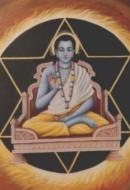
| Kumara Vaisnava Sampradaya:
3 If one finds themselves unable to even perfom activities of propitaion to Lord Krishna in a regular manner then there is an easier method to approach Him for His devotees and that is with a controlled mind renounce the results of one actions and not desire for rewards for what one does. This infers not hankering for the results of performing obligatory rites like fasting from all grains on Ekadasi which is the 11th day of the waxing and waning or the performance of occasional rites such as celebrating festival days of the Supreme Lord with pomp and splendour. The purport is to perform all one's activities without desiring any rewards for the actions. By doing this the mind becomes pure because it is not contaminated by fruitive desires. This will bestow spiritual knowledge and then bhakti or exclusive loving devotion and Lord Krishna's direct realisation in due course of time. 4
|